Exploring the Final Frontier, One Spacewalk at a Time.
A detailed examination of the planned spacewalks, the tasks the astronauts will undertake and the work that needs to be done to prepare the International Space Station for future scientific operations.
The Mission at a Glance
NASA announced live coverage on two Russian cosmonaut spacewalks coming on September 3, and September 9, 2021. The previously planned activities were to be aimed at getting the new science module Nauka ready for use on the International Space Station (ISS).
01 / Why the Spacewalks Matter
The International Space Station (ISS) is a complex laboratory, which is in orbit around Earth. However, some maintenance and installation work is not possible from within the station, and space station personnel have to exit the station in a specialized space suit.
The two planned activities were part of the work of integration of the Nauka module with the station systems. Good preparation would facilitate the scientific and operational function of the module.
02 / Preparing the Nauka Laboratory for launching
The Nauka or Multipurpose Laboratory Module was an addition to the Russian segment of the ISS. Before a new module can be used routinely, crews have to carry out a variety of other external installation and connection activities.
The handrails will be installed on Nauka and the power, Ethernet and data cables will be connected between the module and the Zvezda service module during the planned spacewalks.
03 / Behind the Mission - The Cosmonauts
Roscosmos cosmonauts Oleg Novitskiy and Pyotr Dubrov, who are part of Expedition 65, were scheduled to leave the station in the planned extravehicular activities. Their duty was to do their job in the Russian section of the station, with the help of Space suits of the Orlan family, intended for spacewalks.
The suits give life support, and protection from the vacuum of space and the tools required to perform the difficult tasks outside the station.
04 / What is a Spacewalk?
A spacewalk, or extravehicular activity (EVA), is a complex task that must be carefully planned and coordinated between the astronauts and mission control.
Crew members thoroughly inspect their spacesuits, tools, and safety protocols and the sequence of activities before a spacewalk begins. Astronauts then pass through the airlock and safely transfer to the outside environment. After leaving the station, they install equipment, connect cables, check equipment and perform maintenance. Once the spacewalkers have finished their tasks, they return to the station and conduct post-activity tasks to make sure that they are safe and have completed the activities properly.
05 / NASA's live coverage of spacewalks
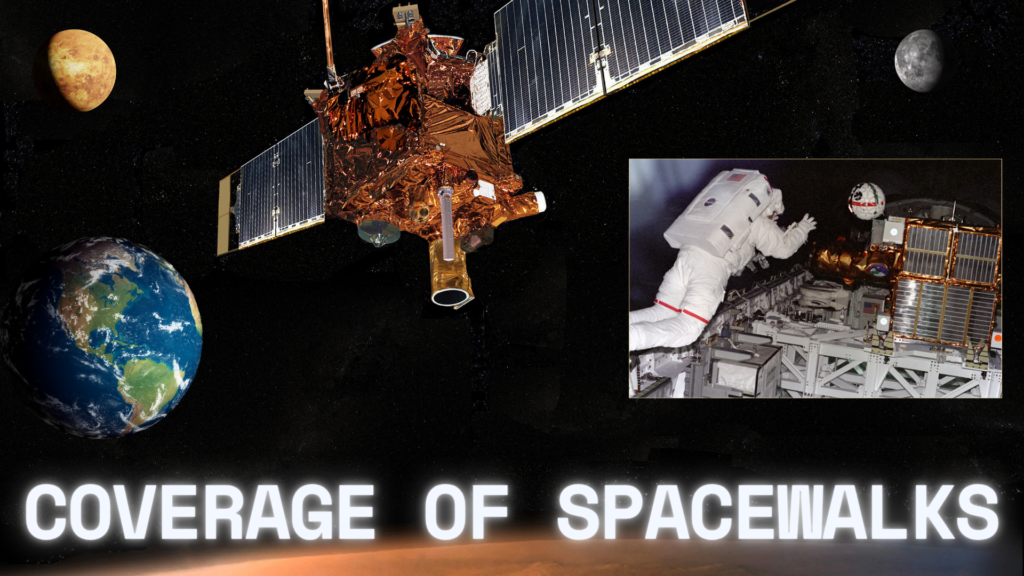
NASA’s live broadcasts enable audiences to follow mission activities as they occur. NASA offered coverage of the two spacewalks in September 2021 via NASA Television, the NASA app and NASA’s website.
Users can also check out NASA’s space station resources for more spacewalk updates, space station research and more spacewalk information.
Visit official NASA resources!
Look for mission data, space station research and spacewalk history at NASA Spacewalk Archive and International Space Station
06 / The Challenges of Working in Space
Spacewalks are challenging tasks. Crew members need to operate in bulky suits, operate on limited resources and need to execute procedures in a harsh environment outside the station.
There are other difficulties, such as getting tools, going around the outside of the station and arranging all the big things with mission control. Just routine installation work demands a great deal of preparation and contingency planning.
07 / Scientific Value of the International Space Station
The ISS enables research in microgravity, technology demonstrations, Earth observation and human spaceflight. The preservation of these experimental and operational systems is provided by maintenance of the infrastructure.
External maintenance and module integration are also significant for accessibility, connectivity and readiness of equipment for future activities.
08 / What These Missions Mean for Future Exploration
Spacewalks gain real-world skills in the process of repairing complicated systems and constructing structures in space. These capabilities will be useful for the proposed long-duration mission, future space stations and other exploration missions.
Reliable external operations aid agencies in learning how to maintain spacecraft away from Earth, where they can get immediate assistance from ground teams.
09 / Looking at the long-term future of space stations
Experience garnered on the ISS continues to be useful as space agencies and companies are building new orbital platforms. The ability to build modules, repair them remotely, and connect to power systems are vital functions for human space explorers to perform.
Lessons learned from station maintenance will be passed on to future laboratories and orbital infrastructure.
10 / Key Takeaways
NASA has announced coverage for two spacewalks by Roscosmos in September 2021, which are to be used for the preparation of the Nauka laboratory module for its operation on the International Space Station (ISS). The planned activities were to install handrails and connect power and data cables for integration of the module with the existing systems of the station.
For the first time the public got to see these complicated orbital manoeuvres and to understand more about the work involved in running a space station. Spacewalks are still crucial for the installation of equipment, repairs, and to keep the ISS operational to enable scientific work and future space exploration projects.